It starts with the basic, foundational idea that there is nothing wrong with us. We are fine. We are complete, complex, human beings leading rich and meaningful existences and deserving dignity, respect, human rights, and the primary voice in the conversation about us.
-Loud Hands: Autistic People, Speaking.
Autism is a brain difference that is basic and fundamental to who we are.
Autistic people develop differently to non-autistic people.
Autistic individuals think, move, interact, sense and process differently to what people might expect.
We are atypical in a world that expects people to be typical.
Autistic people have qualities that make us like other autistic people.
Just like everyone else, autistic people have strengths and struggles. A person may be incredibly talented in some areas and completely disabled in others. The spectrum is not a sliding scale from one extreme to another, but more like an audio equalizer with different levels for different areas of life.
Autism is not a disease or an illness. So, it is not curable or treatable.
It can be challenging, though.
But we think the challenges often come because other non-autistic people don’t understand us or make us feel welcome.
The challenges come because the world is overwhelming.
We need to change the the frame through which we view Autism. We want to dare that overwhelming world to lose the accepted stereotypes about Autism. And the stigmas. And the prejudices.
We need to change the lens so that we see the strength in Autism. And the value. And the beauty.
Autistic Person or Person with Autism?
“Person with autism”
- Person First Language (PFL).
- Used by mainstream society.
- Autism is an unwanted affliction, a negative thing that we should “not allow to define us”.
- The person is separate from their autism.
“Autistic person”
- Identity First Language (IFL).
- Strongly preferred by the vast majority of autistic adults.
- Autism is not something to be ashamed of; it’s a neurological difference, not a disease.
- Autism shapes who we are to such an extent that we can’t be separated from it even if we wanted to (which most of us don’t).
Autistics can identify however they please. The majority support Identity First Language, but any autistics can choose to use Person First Language.
Further reading: https://www.autistichoya.com/2011/08/significance-of-semantics-person-first.html
About Autism
Autism is a developmental disability that affects how we experience the world around us. Autistic people are an important part of the world. Autism is a normal part of life, and makes us who we are.
Autism has always existed. Autistic people are born autistic and we will be autistic our whole lives. Autism can be diagnosed by a doctor, but you can be autistic even if you don’t have a formal diagnosis. Because of myths about autism, it can be harder for autistic adults, autistic girls, and autistic people of color to get a diagnosis. But anyone can be autistic, regardless of race, gender, or age.
Autistic people are in every community, and we always have been. Autistic people are people of color. Autistic people are immigrants. Autistic people are a part of every religion, every income level, and every age group. The communities we are a part of and the ways we are treated shape what autism is like for us.
There is no one way to be autistic. Some autistic people can speak, and some autistic people need to communicate in other ways. Some autistic people also have intellectual disabilities, and some autistic people don’t. Some autistic people need a lot of help in their day-to-day lives, and some autistic people only need a little help. All of these people are autistic, because there is no right or wrong way to be autistic. All of us experience autism differently, but we all contribute to the world in meaningful ways. We all deserve understanding and acceptance.
Every autistic person experiences autism differently, but there are some things that many of us have in common.
- We think differently. We may have very strong interests in things other people don’t understand or seem to care about. We might be great problem-solvers, or pay close attention to detail. It might take us longer to think about things. We might have trouble with executive functioning, like figuring out how to start and finish a task, moving on to a new task, or making decisions. Routines are important for many autistic people. It can be hard for us to deal with surprises or unexpected changes. When we get overwhelmed, we might not be able to process our thoughts, feelings, and surroundings, which can make us lose control of our body.
- We process our senses differently. We might be extra sensitive to things like bright lights or loud sounds. We might have trouble understanding what we hear or what our senses tell us. We might not notice if we are in pain or hungry. We might do the same movement over and over again. This is called “stimming,” and it helps us regulate our senses. For example, we might rock back and forth, play with our hands, or hum.
- We move differently. We might have trouble with fine motor skills or coordination. It can feel like our minds and bodies are disconnected. It can be hard for us to start or stop moving. Speech can be extra hard because it requires a lot of coordination. We might not be able to control how loud our voices are, or we might not be able to speak at all–even though we can understand what other people say.
- We communicate differently. We might talk using echolalia (repeating things we have heard before), or by scripting out what we want to say. Some autistic people use Augmentative and Alternative Communication (AAC) to communicate. For example, we may communicate by typing on a computer, spelling on a letter board, or pointing to pictures on an iPad. Some people may also communicate with behavior or the way we act. Not every autistic person can talk, but we all have important things to say.
- We socialize differently. Some of us might not understand or follow social rules that non-autistic people made up. We might be more direct than other people. Eye contact might make us uncomfortable. We might have a hard time controlling our body language or facial expressions, which can confuse non-autistic people or make it hard to socialize. Some of us might not be able to guess how people feel. This doesn’t mean we don’t care how people feel! We just need people to tell us how they feel so we don’t have to guess. Some autistic people are extra sensitive to other people’s feelings.
- We might need help with daily living. It can take a lot of energy to live in a society built for non-autistic people. We may not have the energy to do some things in our daily lives. Or, parts of being autistic can make doing those things too hard. We may need help with things like cooking, doing our jobs, or going out. We might be able to do things on our own sometimes, but need help other times. We might need to take more breaks so we can recover our energy.
Not every autistic person will relate to all of these things. There are lots of different ways to be autistic. That is okay!
Autism affects how we think, how we communicate, and how we interact with the world. Autistic people are different than non-autistic people, and that’s okay.
Special Interests
Many autistic people have very strong interests, which we call special interests.
For example, some autistic people have a special interest in trains. They think about trains a lot, and know a lot more about trains than other people. They
want to spend most of their time thinking about trains.
There are all kinds of special interests. It might be something big, like science, or it might be something smaller, like a favorite band.
Sometimes, special interests only last a little while. You might only have a special interest for a week. Other times, you could have one for a few months or years. Some special interests stay with us our whole lives.
There might be times when you have no special interests, and there might be times when you have a lot of special interests. All of this is normal.
Special interests are good, because they make us happy! We can use our special interests to help people, and they can be useful in our jobs. Special interests are
really important to most autistic people.
Executive Functioning
Executive functioning is a group of skills that help people stay on track. Staying on track means things like:
○ Following a plan
○ Starting something new
○ Stopping what you are doing
○ Remembering what to do next
○ Moving on to the next thing
Autistic people can have a hard time with executive functioning. It may be hard to make a plan for what to do, start something new, or stop what you’re doing. It may be hard to remember what you want to do.
Executive functioning problems can feel like being lazy, but having problems with executive functioning is not being lazy. You are not lazy. People with executive
functioning problems want to do something, but we might not be able to without help.
Executive functioning is hard for us. We might need extra support, and that’s okay! It’s okay to need help.
Meltdowns and Shutdowns
Meltdowns are when an autistic person can’t control our feelings, and they happen when someone gets too stressed. People having meltdowns might scream or cry, run away, or lose control of our body.
Shutdowns can also happen when someone gets too stressed. A shutdown is when someone stops being able to do anything. We might not be able to talk or
move.
Meltdowns and shutdowns feel scary to autistic people, and they can look scary to other people.
But they don’t happen on purpose, and they are not the same thing as tantrums. Autistic people can’t control when we have a meltdown or shutdown.
Masking
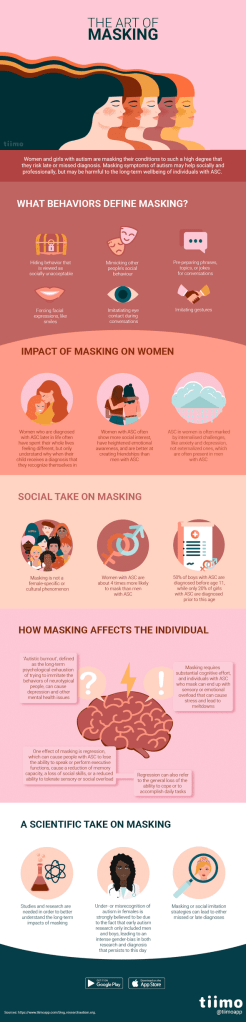
See this article sorced from https://rd.springer.com/article/10.1007/s10803-017-3166-5 on 17.12.2020.
Camouflaging of autistic characteristics in social situations is a common social coping strategy for adults with autism.
First, motivations for camouflaging includes fitting in and increasing connections with others. Second, camouflaging itself comprises a combination of masking and compensation techniques. Third, short- and long-term consequences of camouflaging includes exhaustion, challenging stereotypes, and threats to self-perception.
However, many individuals with autism also report extensive anxiety and depression, especially those with average-to-high levels of IQ and language abilities (Lugnegård et al. 2011). Anecdotal evidence suggests that an individual’s camouflaging can impact their mental health (Holliday-Willey 2015).
Where camouflaging is unsuccessful, strenuous, or if the person feels forced to camouflage, it may be associated with high stress level, low mood and low self-esteem. In addition, the pressure to maintain successful camouflaging may lead to anxiety for individuals with autism.
Camouflaging is not necessarily a beneficial behaviour, and should not be regularly expected or encouraged for individuals with autism, as this may risk increasing mental health problems.
Hull, L., Petrides, K.V., Allison, C. et al. “Putting on My Best Normal”: Social Camouflaging in Adults with Autism Spectrum Conditions. J Autism Dev Disord 47, 2519–2534 (2017). https://doi.org/10.1007/s10803-017-3166-5
Watch this video from Neurodivergent Rebel: Camouflaging Autism – What is Autistic Masking?
Other Thinking Differences
There are lots of ways autistic people think differently. Here are a few:
- Autistic people can notice small things that other people don’t notice. We can notice small mistakes that other people don’t see, like typos.
- We can pay a lot of attention to things other people don’t think are important.
- We can have very good memories for facts, like facts about our special interests.
- Many autistic people like routine. We might like things to be the same every day, or to eat the same foods every day. It helps us to know what will happen each day.
- Change can be scary for us, since things being the same helps us stay calm. Knowing what’s coming helps us make sense of our lives.
- Autistic people sometimes think in black and white. For example, things are either good or bad, we either like or dislike people, or we either can or can’t do something. We can sometimes think in-between, but it can be hard. Black and white thinking can be a good thing. For example, we know when something is right or wrong, and we can help people do the right thing.
- Autistic people learn things differently. We might learn things in a different order, like learning “hard” things before “easy” things.
- We might be great at one thing and bad at another thing.
- We might not get something, and then suddenly get it weeks later.
- We might need to learn some things very slowly, and other things very fast, or we might need to learn something more than once. Because we learn things differently, we can solve problems that other people can’t!
Functioning labels can be harmful
- Being labeled “high-functioning” means your needs get ignored.
- Being labeled “low-functioning” means your strengths get ignored.
- Modifiers like mild/moderate/severe are similarly problematic.
- Autism levels, such as Autism Level 1 or Level 3, are equally problematic for the same reasons.
So what do I call my child? Just autistic. Autistic is great 🙂
Instead of functioning labels, we (and the current DSM) refer to someone’s support needs. Support needs can vary day to day. When speaking about autistic kids and adults, they might have:
- High support needs.
- Daily support needs.
- Occasional support needs.
- Name specific supports they need.
People’s support needs are not a binary or a line. There are hundreds of traits that each individual person, autistic or allistic, needs zero to a lot of help with.
“Asperger’s Syndrome” has been removed from the DSM as of the DSM5. It has been integrated into Autism. This is because Asperger’s Syndrome did not accurately reflect a distinct neurotype from Autism.
Being “at risk” for autism is not only a functioning label, but is also a deliberately vague description of no diagnostic value. Note that “Rett Syndrome” is not a functioning label. The DSM5 classifies Rett separately from Autism under Axis 3, due to its genetic nature. Similarly, PDD-NOS is not a functioning label, but it is no longer in the DSM, having been merged into Autism. Mowat-Wilson Syndrome is also recognized as distinct.
Facts About Autism
Autism should not be cured, rather celebrated autistic forms of communication and self-expression, and for promoting support systems that allow people with autism to live as someone with autism.
- Developmental disabilities such as ASD are brain-based, neurological conditions that have more to do with biology than with psychology.
- Not one person with ASD is affected in the same way.
- ASD is usually diagnosed by the time a child is 3 years old.
- ASD is found in every country, every ethnic group, and very socio-economic class.
- Autism is diagnosed four times as often in boys than in girls.
ASD Includes All Autism Disorders
Recent diagnostic changes with the May 2013 publication of the DSM-5 diagnostic manual, all autism disorders were merged into one umbrella diagnosis of ASD.
A diagnosis of ASD now includes several conditions that used to be diagnosed separately:
- Autistic disorder.
- Pervasive development disorder (PDD-NOS).
- Asperger Syndrome.
Asperger Syndrome
High-functioning autism is different from other disorders on the autism spectrum, in part because it is often diagnosed in older children and teenagers. (More severe forms of autism tend to be diagnosed in toddlerhood.)
By Lisa Jo Rudy, Steven Gans, MD 2020
GILLBERG’S CRITERIA FOR ASPERGER SYNDROME
Sourced from http://www.bbbautism.com/asp_gillberg.htm on 11.12.2020.
1.Severe impairment in reciprocal social interaction (at least two of the following)
(a) inability to interact with peers
(b) lack of desire to interact with peers
(c) lack of appreciation of social cues
(d) socially and emotionally inappropriate behavior
2.All-absorbing narrow interest (at least one of the following)
(a) exclusion of other activities
(b) repetitive adherence
(c) more rote than meaning
3.Imposition of routines and interests (at least one of the following)
(a) on self, in aspects of life
(b) on others
4.Speech and language problems (at least three of the following)
(a) delayed development
(b) superficially perfect expressive language
(c) formal, pedantic language
(d) odd prosody, peculiar voice characteristics
(e) impairment of comprehension including misinterpretations of literal/implied meanings
5.Non-verbal communication problems (at least one of the following)
(a) limited use of gestures
(b) clumsy/gauche body language
(c) limited facial expression
(d) inappropriate expression
(e) peculiar, stiff gaze
6.Motor clumsiness: poor performance on neurodevelopmental examination
(All six criteria must be met for confirmation of diagnosis.)
The Biology of the Autistic Syndromes (Clinics in Developmental Medicine, No 126) by Christopher Gillberg, Mary Coleman 2nd Edition Cambridge University Press 1992.
Signs For Possible Autism
Signs Of Autism In Early Childhood
Parents should ask their child’s family doctor for referral to a developmental paediatrician for assessment if there are concerns with any of the following:
Communication Signs
- No babbling by 11 months of age.
- No simple gestures by 12 months (e.g., waving bye-bye).
- No single words by 16 months.
- No 2-word phrases by 24 months (noun + verb – e.g., “baby sleeping”).
- No response when name is called, causing concern about hearing.
- Loss of any language or social skills at any age.
Behaviour Signs
- Odd or repetitive ways of moving fingers or hands.
- Oversensitive to certain textures, sounds or lights.
- Lack of interest in toys, or plays with them in an unusual way (e.g., lining up, spinning, opening/closing parts rather than using the toy as a whole).
- Compulsions or rituals (has to perform activities in a special way or certain sequence; is prone to tantrums if rituals are interrupted).
- Preoccupations with unusual interests, such as light switches, doors, fans, wheels.
- Unusual fears.
Social Signs
- Rarely makes eye contact when interacting with people.
- Does not play peek-a-boo.
- Doesn’t point to show things he/she is interested in.
- Rarely smiles socially.
For More Info
For more information and an introduction to the alternate reality of Neurodiversity you can download this wonderful ebook:
See this illustrated ebook called Autistic Pride:
Watch this video from Neurodivergent Rebel: https://youtu.be/e0QkgNWz_7U
Sourced from https://autisticadvocacy.org/about-asan/about-autism/ on 12.12.2020.
Sourced from https://www.reframingautism.com.au/about-autism/ on 13.12.2020.
Sourced from https://aut2know.co.za/autism-library/ on 11.12.2020.
Sourced from https://www.autismwesterncape.org.za/understanding-autism/ on 11.12.2020.
Sourced from https://docs.google.com/document/d/1CaAsbCK27iAAQ9awrFyvbyq194NXJ8FgWQIhNBrLhYk/mobilebasic on 12.12.2020. Ask Autistic Adults – Resources for Parents of Autistics.
Sourced from https://theautisticadvocate.com/2020/01/aspergers-syndrome-whats-in-a-name/ on 13.12.2020.
Loud Hands: Autistic People, Speaking. https://autisticadvocacy.org/book/loud-hands-autistic-people-speaking/
YouTube: The Loud Hands Project https://youtu.be/4iVektXsNRI
Jac den Houting TedTalk: Why everything you know about autism is wrong. https://youtu.be/A1AUdaH-EPM
 Life on a {ND} Rainbow