1. The Highly Sensitive Person
2. Sensory Regulation
3. Emotional Regulation

1. The Highly Sensitive Person
A highly sensitive person (HSP) is a person having the innate trait of high sensory processing sensitivity (or innate sensitiveness as Carl Jung originally coined it). According to Elaine N. Aron The Highly Sensitive Person and colleagues as well as other researchers, highly sensitive people, who comprise about a fifth of the population (equal numbers in men and women), may process sensory data much more deeply and thoroughly due to a biological difference in their nervous systems.
This is a specific trait, with key consequences for how we view people, that in the past has often been confused with innate shyness, social anxiety problems, inhibitedness, social phobia and innate fearfulness, and introversion (30% of those with the trait are extroverts). The trait is measured using the HSP Scale, which has been demonstrated to have both internal and external validity. Although the term is primarily used to describe humans, something similar to the trait is present in over 100 other species.

The attributes of HSPs can be remembered as DOES:
•Depth of processing.
•Over aroused (easily compared to others).
•Emotional reactivity and high empathy.
•Sensitivity to subtle stimuli.
HSP students work differently from others. They pick up on subtleties and may think about them a long time before demonstrating their grasp of a subject. If an HSP student is not contributing much to a discussion, it does not necessarily mean he or she does not understand or is too shy. HSPs often have insights they are afraid to reveal because they differ from the common view, or because speaking up is too over arousing for them.
For ideas on teaching sensitive students, see The Temperament Perspective or the final pages of The Highly Sensitive Person. HSPs are usually very conscientious, and gifted with great intelligence, intuition and imagination, but under-perform when being evaluated. This also applies to work situations; HSPs can be great employees – good with details, thoughtful and loyal, but they do tend to work best when conditions are quiet and calm.
Because HSPs perform less well when being watched, they may be overlooked for a promotion. HSPs tend to socialize less with others, often preferring to process experiences quietly by themselves. The ability to unconsciously or semi-consciously process environmental subtleties often contributes to an HSP seeming “gifted” or possessing a “sixth sense”.

Highly Sensitive Children
· Become easily overwhelmed.
· Are cautious in new situations.
· Notice more (changes, subtleties, relationships, other’s people’s moods & expressions, etc.).
· Think more about what they have noticed.
· Have rich inner lives.
· Feel things intensely.
· Are unusually empathic.
· Are highly intuitive.
· Are conscientious.
· Are exceptionally creative.
· Are exceptionally cooperative and kind— except when overwhelmed.
· Are more likely to become fearful, shy, worried, or sad.
· May stand out as “different”.
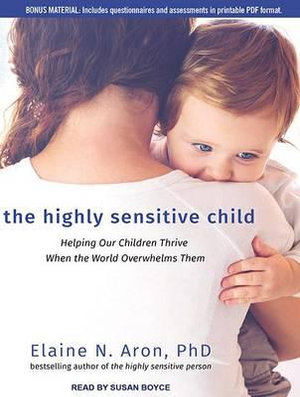
For more detailed info on Highly Sensitive Children, see this:
Sourced from https://hsperson.com/ on 10.12.2020.
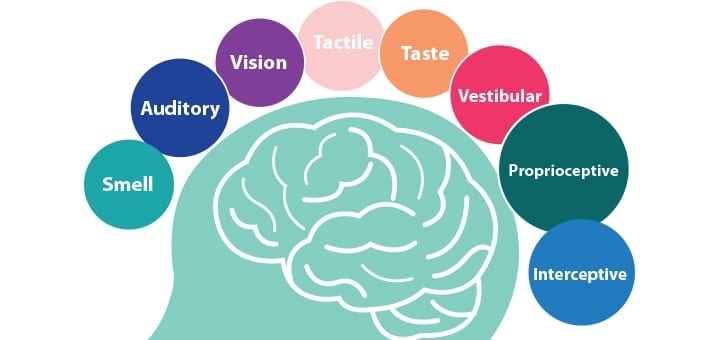
What is a sensory system?
Many people think the sensory system is made up of five senses; however, the sensory system is comprised of eight senses. Below is a list of the eight senses that contribute to SPD:
1. Visual (sight) is a child’s ability to see things such as colors, shapes, depth, lighting, and to scan and filter out visual information.
2. Auditory (hearing) is a child’s ability to hear, listen, filter, and selectively attend to auditory stimuli. It also affects speech and language.
3. Tactile (touch) is anything that can be touched and felt on a child’s body thru their skin receptors.
4. Olfactory (smell) is a child’s ability to smell if something is good or bad. The sense of smell is connected to emotions in the brain and can cause feelings of comfort and alarm.
5. Gustatory (taste) is the child’s ability to determine what foods and/or drinks they like and what to stay away from. It is a way for a child to decide if something is dangerous to ingest based on if it tastes good or bad.
6. Vestibular (located in the inner ear and helps with balance) is the child’s ability to identify when they are sitting, lying down, upside down, standing, spinning, etc.
7. Proprioception (senses from muscles, joints, and ligaments) is a child’s internal sense that allows them to know where their body parts are “in space” and what they are doing with their body parts without looking for them.
8. Interoception (senses from internal organs) is the child’s ability to identify internal functions such as hunger, thirst, and when to use the bathroom.
2. Sensory Regulation
Since a child with sensory regulation issues has trouble organizing and responding to information that comes through their senses, they will often exhibit one of the two symptoms listed below:
2.1 Oversensitive Symptoms (Hypersensitivity)
These children avoid sensory input because it is too overwhelming for them. They react to a wide range of triggers (some are listed below) that may lead to a sensory meltdown:
- Easily startled and shows extreme fear to sudden and loud sounds and noises (i.e., toilets flushing, crowd cheering, fire drill, etc.).
- May be distracted by background noises that others don’t hear.
- Easily overwhelmed by people and crowded spaces and seeks out quiet spots.
- Is bothered by bright lights.
- Uncomfortable with touch and often avoids hugs and cuddling.
- Refuses to wear itchy or uncomfortable clothing.
- Has a strong reaction to certain foods, smells, or textures and refuses to try new foods.
- Gets upset about small changes in routine and trying new activities.
2.2 Undersensitive Symptoms (Hyposensitivity)
- Constantly touching objects.
- Squirms and fidgets.
- Easily distracted.
- Plays rough.
- Has a high pain tolerance.
- May harm others or pets because they are unaware of their own strength.
- Looks clumsy or uncoordinated by bumping into things.
- Takes physical risks that can be dangerous at times, and known as a “thrill seeker”.
- Invades others personal space.
How to help a child with Sensory Regulation Issues?
The sensory system of a child with sensory regulation issues is challenged daily.
With that being said, it is important to find the appropriate support, therapeutic strategies, toys, clothing, and modifications to implement in order to help a child organize their sensory system.
The most important self regulation techniques are not taught but will be instinctive and intuitive for the autistic person:
- Stimming
- Engaging with special interests, especially art, music etc.
- Removing self from whatever is over stimulating/ disruptive – energy banking instead of energy draining activities.
Other helpful supportive activities that can be explored:
☆ SENSORY DIET
Sensory Diet is a treatment approach in which an Occupational Therapist designs a list of physical activities that a child can do throughout the day either at home or school. These sensory diet activities are designed to meet the sensory needs of the child and to provide them with sensory input. Activities can either calm (i.e., doing wall push-ups, jumping on a trampoline) or arouse the sensory system (i.e., bounce on yoga ball or swing.)
☆ SENSORY ROOM
Sensory Room is a specially designed room that combines a variety of sensory stimuli.
The rooms are designed in a way to help children with sensory integration issues engage and explore with their senses in a safe and non-stressful environment.
These rooms usually have dimmed lights, calming sounds, and colors, aromatherapy, and have different play stimuli that provide different sensory input. Play objects can include crash pads, bubble tubes, water beads, and swings… just to name a few items.
☆ EXERCISES
Exercises for sensory regulation issues depending on the child’s sensory needs, there are countless exercises that a child can do to help organize their sensory system.
Sensory exercises are beneficial because they prompt the brain to process information more effectively, thus helping the child respond more appropriately.
Below are a few examples of exercises that a child with can do to target different areas of sensory input:
- Tactile – exercises that allow a child to explore and organize their sensory system through touch. Example exercises are filling a tub with beans, rice, or water beads and having the child put their hands and/or feet in the tub, playing with shaving cream on a table, and the brushing protocol.
- Vestibular – exercises that stimulate the vestibular system in the inner ear. Example exercises are any exercises that stimulate the vestibular system in the inner ear. Example exercises are swinging, rolling on the floor or a yoga ball, and riding a scooter board on the stomach.
- Proprioceptive – exercises that help a child feel their muscles and joints. Example exercises are jumping jacks, wheelbarrow walking and clapping games.
- Oral-Motor – exercises that involve sensory stimulation of the mouth that include lips, tongue, and jaw. Example exercises are chewing gum, eating foods with different textures and strong tastes, and blowing exercises like using a straw to blow bubbles or blowing a whistle.
☆ SENSORY TOYS
Sensory Toys are toys that are designed to help soothe a child. Below is a list of toys that are best suited for specific sensory systems:
- Visual – Lava lamps, bubble tubes, any toy that lights up or spins.
- Auditory – Rainmaker toys, noisy toys, calming music.
- Tactile – Water beads, moon sand, shaving cream, slime, fidget spinners.
- Olfactory – Scented markers, scented stickers, scratch-n-sniff books, scented bubbles.
- Gustatory – Chewing gum, sensory chew toys.
- Vestibular – Scooter board, therapy swing, steamroller, balance board, sit and spin.
- Proprioception – Trampoline, pogo stick, Hippity Hop.
☆ SENSORY CLOTHING
Sensory Clothing – Children with sensory regulation issues are often bothered by their clothing. This can range from the tags on their clothes, to textured material, to seams on pants and socks. When clothing starts to interfere with a child’s ability to function daily, clothing modifications need to be implemented.
Below is a list of some adaptive clothing options and therapeutic items that children can wear:
- Compression or undershirts.
- Clothes made of soft material and don’t have any tags or seams.
- Smart Knit Seamless Socks.
- Weighted Vests.
- Noise Reduction Headphones.
- Sensory Sock.
- Weighted Blanket or Lap Pad.
- Chewable Jewelry.
- Fidget Jewelry.
Since Sensory Processing Disorder is lifelong, children with sensory issues can learn coping strategies to help them live productive and happy lives.

3. Emotional Regulation
The labour of emotional regulation, the futility of that labour when our efforts are foiled, and the loss of regulation and control are both challenging and profoundly unpleasant to most Autistics. So, being unsuccessful in regulating our emotions is as intolerable for Autistics, as it is for those around them. More so, I would argue.
-Dr. Melanie Heyworth
What is emotional regulation?
What exactly are we asking our Autistic children to do?
At its core, emotional regulation is about exercising control over our emotional reactions to stimuli. It is a process which allows us to register, analyse, assess, control, and express an emotional response that is considered socially appropriate in the context and circumstances.
Our success (or lack thereof) at emotionally regulating is usually judged by our consequent actions (so our external expression of that regulation).
Generally we are judged by whether we have taken an action that is appropriate (as deemed by observers) to the triggering emotion, inhibiting an action that is unacceptable or inappropriate to the triggering emotion, or modulating or tempering our reactions to the triggering emotion.
As you might notice, we tend only to judge emotional regulation by its negative presentation, or its lack.
To be fair, it is difficult to “see” a child (or an adult) modulating or tempering a reaction or inhibiting an action unless they communicate that they are doing so explicitly. Really, we only “see” when they fail in their efforts to reduce or moderate their emotional reaction.
How then do we help our children build, practise, and maintain their emotional regulation, their self-regulation?
How do we give them the skills to manage the frequently overwhelming cacophony of thoughts, emotions, and actions?
How do we support our Autistic children – any children, in fact – to respond rather than react when they experience “big emotions” and face stressors?
Co-regulation: connection not correction
Research shows that we can cultivate our children’s self-regulation by demonstrating and modelling our own self-regulation through the process of co-regulation.
At its core, co-regulation is about providing the optimal conditions for our own and our child’s self-regulation, as well as maintaining a calm demeanour fuelled by a desire for connection not correction (a fabulous phrase I have borrowed from L. R. Knost).
– Dr. Melanie Heyworth
Establishing optimal conditions
Let’s first look at establishing optimal conditions for emotional regulation. The ideal context for co-regulation is a predictable, safe and sensory-friendly environment.
Obviously, it is not always possible to ensure our children are operating within this kind of environment. But let’s think about the environments you can control, like your home.
There’s no doubting that the skill of emotional regulation is an essential and affirming one to acquire. How then do we help our children build, practise, and maintain their emotional regulation, their self-regulation?
How do we give them the skills to manage the frequently overwhelming cacophony of thoughts, emotions, and actions?
How do we support our Autistic children – any children, in fact – to respond rather than react when they experience “big emotions” and face stressors?
First things first, your child needs a specific location, an explicitly designated place in their home, that is for regulation. This area needs to be a buffer for your child against environmental stressors and triggers that might undermine their self-regulation, not reinforce it.
For example, if your child is sensory defensive, it might be an empty, accessible cupboard into which you put cushions, a favourite toy, and noise reduction headphones. It might be a blackout tent with a foam-filled beanbag.
For a sensory seeker, it might instead be a sensory pod swing, a trampoline and crashmat, a playlist of music, a sensory toolkit with tangles and stress balls, and a bag of sour chews.
For some, it may be access to a steaming shower, a bubble bath, or chewing ice. For others, it may be a combination of any or even all of these or something completely different again. The key for the safe space is to create something that is calming and settling, not arousing.
The point of this safe space is that it is an inviolable, predictable place to which your child can retreat that will sustain their efforts to self-regulate by lowering any perceived sensory or environmental threats.
Ideally, it should be co-constructed with your child, and their preferences are paramount in making the area work (that is, get their input into designing the space, into what might work and what needs to be included).
A safe and predictable environment, though, is about more than physical or sensory stimuli. It is also created through consistent routines and expectations, and through well- and pre-defined logical consequences to behaviours.
This will look different for every family. For example, some children appreciate a prompt to alert them to their rising emotional state; their parents may employ a “safe” word to signal to their child that they may find it easier to regulate in their safe space.
For other families, their child might interpret any prompt as a demand, which is in turn perceived as a threat, increasing adrenaline and cortisol, and thereby making the child’s regulatory work so very much harder. For those families, a visual reminder could be more successful than a word or verbal communication, or the carer sitting quietly next to the safe space.
What is a constant, however, is that the consistency of adult expectations and response is absolutely crucial to establishing safety. It does not engender a feeling of safety if your child cannot predict what will or won’t trigger an emotive response from you.
How often has a little thing – let’s say a challenge, such as tying shoelaces after good money spent on OT and years of practice – been tolerated on a quiet day, when no pressure or timeline is imposed, and you have the patience and capacity to support your child’s fumbling efforts, only to be the cause of your profound frustration-fuelled anger on another day on which you are frazzled and running late for an important appointment?
Ask yourself: can your child expect a consistent calm from you, even in moments of exasperation or provocation?
-Dr. Melanie Heyworth
Your child will feel most safe if they can expect fair, just, and equitable consequences that logically follow on from their behaviour.
There is a strong protective factor in such consistency and predictability.
“What you do speaks so loudly that I cannot hear what you say” (Ralph Waldo Emerson)
Resources for Self Regulation
- https://learn.hes-extraordinary.com/printables
- https://hes-extraordinary.com/
- https://www.alertprogram.com/alert-program-overview-supporting-children-with-autism/?doing_wp_cron=1606822071.3894200325012207031250
- https://www.alertprogram.com/
- https://alertprogram4all.com/
- https://www.alertprogram.com/parents/
- “1001 Great Ideas for Teaching and Raising Children with Autism or Asperger’s, Revised and Expanded 2nd Edition” by Ellen Notbohm, Veronica Zysk.
- Self-Regulation Interventions and Strategies: Keeping the Body, Mind & Emotions on Task in Children with Autism, Adhd or Sensory Disorders by Garland, Teresa.
Sourced from https://www.reframingautism.com.au/emotional-regulation-part-one-what-is-it-and-why-is-it-so-hard/ on 12.12.2020.
Sourced from https://www.reframingautism.com.au/emotional-regulation-part-two-using-co-regulation-to-teach-emotional-regulation/ on 12.12.2020.
Sourced from https://www.aspergerstestsite.com/748/sensory-processing-disorder-adults-autism on 10.12.2020.
Sourced from https://www.autismparentingmagazine.com/sensory-processing-disorder/ on 10.12.2020.
 Life on a {ND} Rainbow