
ABA therapies. Are they helpful or harmful to autistic children?
As an Åã parent of an autistic child I know how challenging it can be. Especially when you see your child struggling in a specific area. And I know how crucial it is to find kind, gentle, effective support and helping strategies to empower our families to thrive in this world.
To quote Oprah, “When we know better, we do better.” So, I hope this knowledge will empower you to make an informed choice at a time when you as parents are often vulnerable and desperate to find the help and support that your family needs.
I found that in the greater autism community there are very strong advocacy against any behavior modification, forced compliance training, teaching social masking, and trying to basically “fix” Autism/ Neurodiversity.
There are of course wonderful supportive therapies and interventions out there that are not ABA. Especially to help families with co-occurring conditions like anxiety, depression, or just to support functioning in the areas that are negatively impacted, learn how to provide accommodations and how to thrive as a neurodivergent person in a predominantly neurotypical world.
The basic difference is the approach: Pathology Model vs. Neurodiversity Model (Neurodiversity-affirming Approach)
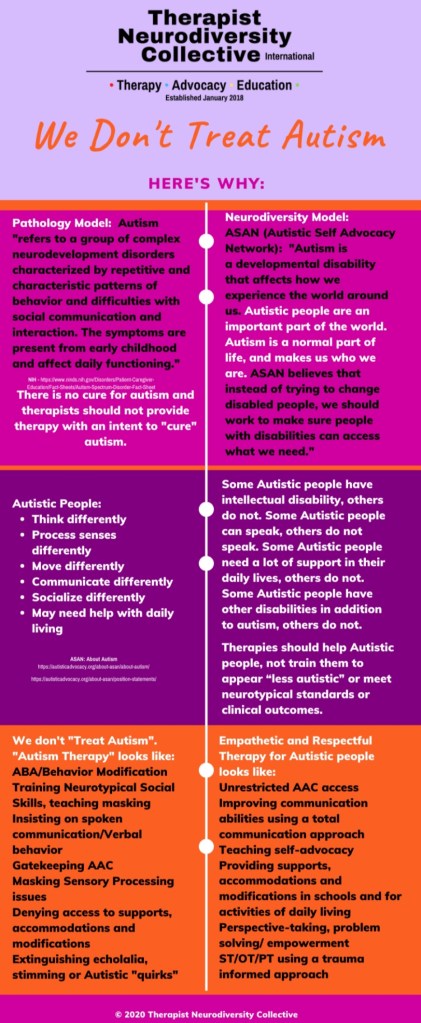
Why ABA is not so great
- First off, ABA does not work: Data shows that it literally doesn’t work. So why do we keep doing it?
- ABA is focused on making life easier for the family instead of what is best for the child.
- ABA Seeks to stop kids from being autistic by repressing natural and healthy things like stimming, while forcing uncomfortable and harmful things like eye contact.
- Many autistic adults have PTSD as a direct result of ABA. This has been covered in peer-reviewed literature (see here).
- ABA is a form of conversion therapy, similar to the kind which has been outlawed in several countries and states for LGBT+ children. Conversion therapy was outlawed in those situations due to it being abusive, resulting in high PTSD rates, and causing suicides. ABA is the same.
Known ABA knockoffs, competitors, brand names, components, and rebranding
Because of insurance, marketing, and a desire to remain profitable; there are many competitors to ABA that use the exact same techniques under different names or derived names. These are all as abusive as ABA. This is a non-all-inclusive list of these knockoffs, competitors, brand names, and rebrandings.
- TEACH Autism is a brand-name competitor.
- Gemini/Geminii is another brand name competitor.
- “Modern ABA” is just ABA which actively denies that it is abusive rather than just ignoring it, and might claim to frown upon shock treatment.
- “New ABA”: see “Modern ABA”
- Classic ABA is a retroactive marketing term that refers to ABA outside of the “modern ABA” label.
- Positive Behavior(al) Intervention: A hippy rebranding of ABA.
- Positive Behavior(al) Support: See Positive Behavior(al) Intervention.
- Lovaas treatment / Lovaas Approach is another brand-name competitor.
- BCBA, CAS, RBT: these refer to an individual inflicting ABA, rather than the operational model. These labels are sometimes also used to refer to ABA for insurance reasons.
- BHRS is a Pennsylvania-specific government brand.
- ABA-BHRS is a hybrid.
- Aversives are a partial type of ABA.
- Whole Body Learning is a usual component of ABA.
- Son-Rise is a brand name of family-focused Positive Behavior(al) Intervention.
- PBS, Positive Behavior Supports: and the associated corporation, is a UK-based brand name competitor.
- Positive Behavioral Interventions and Supports, PBIS: A ripoff of PBS.
- Play Based ABA: This is ABA which pretends to be less abusive by using Montessori techniques.
- Verbal Behavior Therapy, VB. Also known as VB MAPP.
- Pivotal Response Training / Pivotal Response Treatment / Pivot Response Training / Pivot Response Treatment (PVT). A regional relabeling.
- Natural Language Paradigm, an old name for PVT. Not to be confused with Natural Language Processing, which is a domain of software engineering.
- Early Start Denver Model (ESDM). An ABA derivative.
- Early Intensive Behavioral Intervention, EIBI / Intensive Behavioral Intervention, IBI.
- Discrete Trial Training is a component of ABA.
- Incidental Training / Incidental Teaching is another ABA component.
- Relationship Development Intervention is a brand name derivative of ABA that almost always overlaps with ABA directly.
- The PEERS program: A brand name ABA derivative.
- Social Skills Training: Basically generic-branded ABA.
- Behavior Analytic Service, BAS: another brand name.
Some other therapy providers will inflict ABA under the guise of other therapies or as a modification of them. For these reasons, it’s important to look for warning signs.
A note on Early Intervention
- “Early Intervention” is not a helpful description of services. It’s an umbrella term that can cover anything from therapies that may be helpful, useless, or abusive.
- If you do not know what your early intervention covers, ask the provider. If what is being done is child abuse, such as ABA or its knockoffs; pull your child out of it. If the provider evades the question or refuses to answer, that’s a red flag.
Legitimate Therapies
Different people may or may not benefit from different therapies. This list is not an endorsement of individual therapies and especially not individual therapists, but there are wonderful neurodiversity-affirming therapist out there, e.g. The Neurodiversity Center
- Occupational Therapy (for Executive Functioning support)
- Play Therapy, Art Therapy or Talk Therapy/Psychotherapy
- Speech Therapy (for Learning differences or Language processing differences)
Note that you should always verify that the therapies that you have agreed to are exclusively the therapies being provided. Make sure that abuse is not being inflicted. For example, some people charge for one but perform both OT and ABA.
Additionally, occupational therapy is a VERY broad family of services, so if you are asking any questions regarding it, it is usually helpful to give more details on what services are being done. It will help us give more detailed and helpful answers. If you don’t know what is being done, ask the provider.
A general rule of thumb: Autism is not a disease and thus does not require treatment. Autism is simply a case of humans being different like being left handed or having blonde hair. It is not a problem you need to solve.
That said, if your child is experiencing problems that they require help with, then helping them is a good idea. For example, if they are experiencing motor control issues, then occupational therapy without abusive practices could be a good choice. If they are experiencing the aftereffects of trauma, then therapy for processing trauma can be helpful.
Autism doesn’t require therapy, but some other stuff does; and getting therapy for stuff that does require therapy is a good thing as long as it is done in an ethical manner.
-Ask Autistic Adults
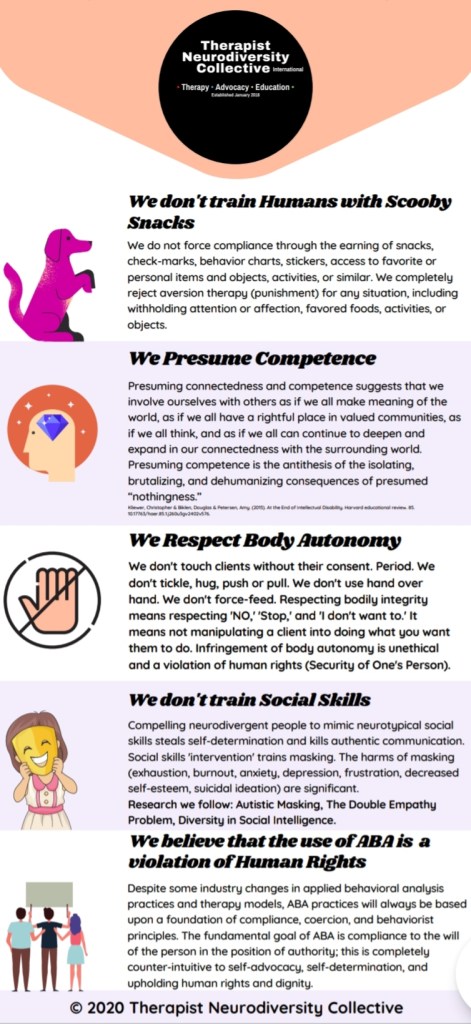
8 Signs of a Respectful & Empathetic Therapist
Sourced form https://therapistndc.org/education/ on 8.12.2020.
Top Tips & Advice from Autistic Adults
Sourced from FB group ” Ask Autistic Adults”
https://www.facebook.com/groups/2138776736451241/?ref=share
☆Comment 1
Before you do anything:
1. Love and accept your child. Know your child is fully whole, human and has a wonderful life ahead.
2. Listen to autistic people.
3. Understand the purpose of ABA is to train autistic children to pretend they are non-autistic so when you ask for alternatives by clear what you’re looking for.
4. Remember Autistics are different in our development. Don’t panic if we don’t know how to do something at 4 that non-autistic do. Chances are that non-autistic kids don’t know how to do things that we can. We develop differently so measuring us off non-autistic milestones is nonsensical.
So now you want a way to help your child with what?
Sensory: Occupational Therapist or find things to distract. Distraction from offensive sensory input can stop sensory overload OR help The Autistic Community with its campaigns to change our environment, then we wouldn’t have sensory overload at all!
Behaviors: listen to autistic people who can explain all of this to you. Behavior is
communication, stimming is part of our language and part of our learning process. ‘Challenging behaviors’ should not be happening, if they are then something is radically wrong in your child’s life. It’s either sensory or emotional. This can be caused be someone misinterpreting them continually because they are not listening to autistic people or by the sensory environment. Understanding your child and studying their language will teach you what you need to change. Meltdowns have nothing to do with being autistic. Every human being melts down under severe stress. If meltdowns are happening then it’s up to you to find the stressors and remove them permanently.
Speech: speech therapy can help or you can begin to learn about AUTISTIC LANGUAGE and culture so that you can learn your child’s language instead of putting them through years of therapy. Autistics communicate all the time, others just don’t interpret our language. Stimming is part of our language, as is posture, gesture, movements and sounds (same as every other human). There are lots of AAC devices on the market, AAC users recommend you start teaching them early on, everyone has the right to communicate.
Play: Autistics play in autistic ways, that’s why autistics become experts, inventors and are natural problem solvers and environmental communicators. There is no need to teach your child to play.
Engaging: make it interesting or join in with what we’re doing.
It’s important to remember that Communication for some of us is not a transfer of information or words. It is sharing a space and time with another. We ARE engaging just by being. This should be respected. Words are our second language so it’s important you remember that.
Learning skills: we learn things best when the motivation comes from within, when there is an actual need for us to learn to do something. Also we may do things differently but they’ll serve the same purpose and that’s ok. We learn best by experiencing, thinking, touching, figuring out and stimming is actually part of our learning process. We stim to store the learning, we stim while we’re processing or figuring out. We stim to recall our learnings. Stimming is not just for self regulation.
Learning, like everything we do is an emotional process for us. This is why we have ‘special interests’ or passions. We need a rich and full understanding and we need to know the REASON why we have to learn certain things. If it’s not logical then good luck trying to make us learn it.
Social skills: autistics have ‘social skills’ . We have our own language and culture so we don’t need to become someone else. We do need some help with non-autistic language and culture so we can learn about that the same way we’d learn about any other language and culture. Through role play, games and figuring stuff out. It’s important that our autisticity is respected at all times as a valid culture and language and that you realize that ‘processing delays’ are often just me translating your language into mine and then back into yours so you can understand.
Building confidence & Self belief: look for activities that your child enjoys and will thrive at. Drama, music, art, dance, Lego, horse riding ….the list is endless. Autistic kids can do activities too, everything doesn’t have to be a therapy!
Peers: find other autistic people , we tend to get on with each other. Also some of us can enjoy the company of older or younger kids. I’m 42. My friends range from 22 to 65 …. why do 8 year old kids have to only be friends with other 8 year olds?
☆ Comment 2:
Here’s the evidence of ABA being bad, the research, the facts. This list includes a bit on kids looking like they enjoy ABA and some other resources.
Secondly, in the reply to this comment, will be my write up, including why parents seem to like it and why kids don’t always seem to show trauma immediately.
So, starting off.
Peer reviewed source that ABA fosters prompt and reward dependency, leads to low self initiative:
https://www.tandfonline.com/doi/full/10.1080/23311908.2019.1641258
https://www.emerald.com/insight/content/doi/10.1108/AIA-08-2017-0016/full/html
The efficacy of the program has been called into question by the US govt:
Peaceful parenting and ABA treating problems we don’t have:
https://peaceigive.com/2020/02/04/aba-treats-a-problem-your-child-doesnt-have/
An article highlighting how ABA is abusive from an autistic perspective with videos:
On kids that appear to enjoy ABA:
The Great Big ABA Opposition Resource List:
https://stopabasupportautistics.home.blog/2019/08/11/the-great-big-aba-opposition-resource-list/
PCIT (parent child interaction autisticmama.com/even-new-aba-therapy), occupational therapy, physical therapy, and non-ABA therapy are immensely helpful and can specifically target certain skills to work on in a healthy way. Here is more information as well:
http://www.thinkingautismguide.com/2017/04/if-not-aba-then-what.html?m=1
And the aggression checklist for identifying aggression:
http://wearelikeyourchild.blogspot.com/2014/05/a-checklist-for-identifying-sources-of.html?m=1
Lastly a major shoutout to Dr. Ross Greene’s book The Explosive Child and the Plan B parenting method as way better than ABA. He has a website www.livesinthebalance.org where he does podcasts at too and you can get The Explosive Child on Amazon and The B Team parents around his philosophy.
Sourced from
https://therapistndc.org/education/ on 10.12.2020.
https://docs.google.com/document/d/1CaAsbCK27iAAQ9awrFyvbyq194NXJ8FgWQIhNBrLhYk/mobilebasic on 12.12.2020.
See this Resource List on why ABA is experienced as harmful and even abusive/ traumatizing:
https://stopabasupportautistics.home.blog/2019/08/11/the-great-big-aba-opposition-resource-list/
Further reading:
 Life on a {ND} Rainbow